
How Clever Marketing People Get You to Spend
- October 29, 2026
How Marketing People Get You To Buy
We are moving into Black Friday and Blue Dot Sale time of year, when retailers pull out all the stops to convince you to part with your hard earned cash.
Behind every flashy advert, big red SALE sign and “limited time offer” are clever marketing people who have carefully planned how to get your attention, make you want something and encourage you to buy it right now.
Some of these tricks have been around for decades. Others have been given a modern online makeover.
Let’s look at some of the most common marketing tricks you are likely to see over the next few weeks, so you can spot them before they catch you.
Marketing Tricks To Watch Out For
- False urgency
“Today only.”
“Sale ends at midnight.”
“Last chance.”
These messages are designed to make you feel that you have to decide immediately.
The less time you have to think, the less likely you are to compare prices, check your budget or ask yourself whether you really need the item.
- Fake scarcity
“Only 2 left.”
“Almost sold out.”
“Limited stock.”
Scarcity makes things feel more desirable.
When we think something is about to disappear, we can suddenly want it more than we did five minutes earlier.
Sometimes stock really is limited. But the message can still be used to pressure you into buying quickly.
- Inflated original prices
A big discount always looks impressive.
But what was the item really selling for before the sale?
Sometimes prices are increased before a major sales period, making the later discount look much bigger than it really is.
A sign that says “Was R1 999, now R999” sounds fantastic.
But if the item normally sold for R1 099 a few weeks earlier, the real saving is much smaller.
- Anchoring
Retailers often show you a very high price first.
That first price becomes your reference point.
If you see R2 000 first and then R1 200, R1 200 can suddenly feel cheap.
You may stop asking whether R1 200 is actually good value and instead focus on the R800 you have supposedly saved.
- Loss leaders
Some sale deals really are excellent. This is why things get tricky at this time of year.
A retailer may sell a few popular products at very low prices to get you through the door or onto the website.
In marketing and retail that product is called a loss leader.
The hope is that once you are there, in the shop or online, you will buy other things too.
So yes, the deal might be genuine. But it can still be the gateway to spending much more than you planned.
- Decoy pricing
Imagine three options.
One is cheap but basic.
One is expensive.
One sits in the middle.
Sometimes one of those choices is deliberately made poor value so that another option looks like the obvious choice.
You may think you carefully chose the best deal.
But the choices may have been designed to guide you towards the product the retailer wanted you to buy.
- Free delivery thresholds
“Free delivery when you spend R750.”
Your basket comes to R620.
Suddenly you are looking for another R130 worth of products so you can avoid paying R80 for delivery.
That can mean spending R130 to save R80.
Free delivery is nice, but only if you were already going to spend enough to qualify.
- Buy more to save more
“Buy 2 and get 1 free.”
“Spend R1 000 and save 20%.”
“Buy 3 for R300.”
These offers encourage you to buy more than you originally wanted.
If you genuinely need three of something, that may be a good deal but if you only needed one, you have fallen into their trap.
- Charm pricing
R999 feels cheaper than R1 000.
R499 feels cheaper than R500.
The difference may only be R1, but psychologically the lower first number matters.
Retailers have used this trick for years because it works.
- Black Friday Deals
Black Friday advertising often focuses on a few spectacular bargains.
These deals are designed to attract attention and create excitement. The hype and Fomo is real. But like loss leaders, once you are shopping, many of the other products may have much smaller discounts.
Do not assume that everything in a Black Friday sale is automatically cheap.
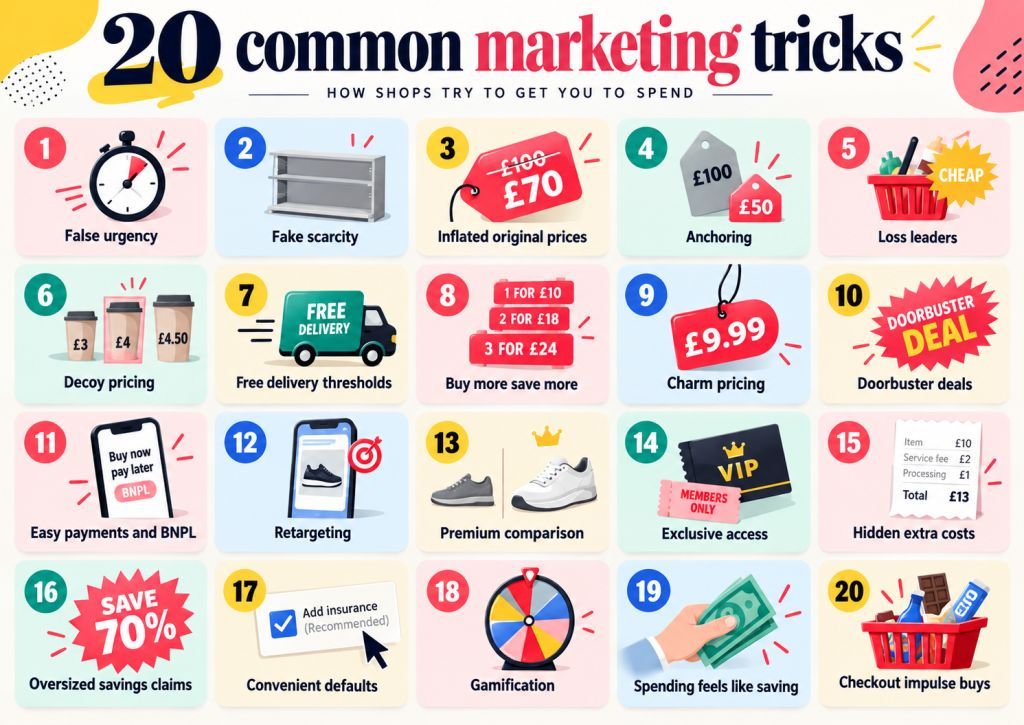
- Easy payment framing
A large price can feel painful.
A small monthly payment feels much easier.
Instead of showing you R4 800, an advert may focus on “only R400 per month”.
Buy now pay later services use a similar idea by breaking a purchase into smaller chunks.
That smaller number can make the purchase feel affordable even when the total amount is still large.
Some consumers in debt review have also managed to access buy now pay later services in the past. That makes this something to be particularly careful about.
A smaller payment is still spending.
- Retargeting
Have you ever looked at a pair of shoes online and then suddenly seen adverts for those same shoes everywhere?
That is retargeting.
The danger is that seeing something again and again can make it feel more familiar, more desirable and harder to forget.
- Premium comparisons
A retailer may place a very expensive option next to the product they really want you to buy.
Suddenly the second product looks reasonably priced.
A R900 item can feel expensive on its own.
Put it next to a R2 500 version, and R900 can suddenly look like good value.
- Exclusive access
“VIP sale.”
“Members only.”
“Early access.”
Making something feel exclusive can increase its appeal. You may feel that you have been given special access to a bargain that other people cannot get.
And let’s be honest, sometimes the deal is genuinely exclusive.
But the feeling of being treated as special can also encourage you to buy something you had not planned to buy.
- Hidden extra costs
You find a product at a great price.
You add it to your basket.
You go through several steps of the checkout process.
Then the extra little costs start to appear.
Delivery.
Service fees.
Processing fees.
Installation charges.
By this point you have already decided that you want the item, so you may be more likely to accept the extra cost.
Always look at the final amount, not just the advertised price.
- Oversized savings claims
SAVE R2 000!
50% OFF!
HUGE DISCOUNT!
Retailers often make the saving the biggest thing you see.
But the amount you are actually spending may be shown much smaller.
The important number is not how much they say you saved. The important number is how much money is leaving your account.
- Convenient defaults
When shopping online, you may find that an extra option has already been selected for you.
Insurance.
An extended warranty.
A subscription.
An accessory.
You may have to actively untick a box to remove it. This is naughty behaviour.
Always check your basket before just hitting pay.
- Gamification
Spin the wheel.
Scratch to reveal your discount.
Collect points.
Unlock the next reward.
Shopping can be made to feel like a game. And you can fall for it even if everyone gets the same special treatment. Gamification makes shopping more fun, but it can also encourage you to keep browsing, keep clicking and keep spending.
Remember: the goal of the game is not necessarily for YOU to save money.
- Spending feels like saving
This is one of the most powerful tricks of all.
You buy something for R800.
The advert tells you that you saved R400.
You walk away feeling R400 richer.
But you are not.
You still spent R800.
You only saved money if you genuinely needed the item and would have bought it anyway. Maybe just add it to your Wishlist for now and track prices to see if it gets cheaper.
- Checkout impulse buys
Supermarkets have been doing this for years.
Sweets, chocolates, batteries and other small items sit near the tills.
Online shops do it too.
“Customers also bought…”
“Add this for only R49.”
“Complete your order with…”
You have already decided to spend money, so adding one more small item can feel harmless.
A few harmless extras can quickly add up.
Some Deals Really Are Good
It is worth saying that not every sale is fake.
Sometimes a retailer really does clear old stock. Sometimes a loss leader really is an excellent deal. Sometimes Black Friday prices genuinely are much lower than usual.
The problem is not that every sale or offered discount is bad.
The problem is that a good deal can pull you into buying other things you never planned to buy. That is why it helps to decide what you need before you start shopping.
A genuine bargain is only a bargain if you actually needed it.
Needs Or Wants?
Before you buy something, stop and ask yourself a simple question:
Do I actually need this, or do I just want it because it is on sale?
A discount does not somehow turn a want into a genuine current need.
Before spending, ask:
Did I want or need this before I saw the sale?
Is this already in my budget?
Do I already own something that does the same job?
Will buying this leave me short for groceries, transport or other essentials?
Will I actually use it regularly?
What happens if I do not buy it today?
That last question is a good one. In most cases, nothing terrible happens. Instead, you simply keep your money till you really do need it one day.
Do Not Let Them Rush You

Retailers know that time pressure works.
That is why you see countdown timers, flashing warnings and last chance messages.
The faster you are encouraged to make a decision, the more useful it can be to slow down.
For an unplanned purchase, give yourself some time.
Leave the website.
Walk out of the shop.
Compare prices.
Check your budget.
Think about whether you still want the item once the excitement has passed.
If it really is something you need, you can make the decision with a clear head later.
Sales Come Around Again
One of the easiest marketing tricks to fall for is the idea that this is your only chance to get a good deal.
It usually is not. Retailers will find almost any reason to have another sale.
Black Friday, Christmas, Easter, Mother’s Day, Father’s Day, Summer specials, Winter specials, Payday specials, Clearance sales, End of season sales, Birthday sales.
The list goes on and on. There is always another reason for another promotion. So do not let a “last chance” message convince you that you have to spend today. There will almost always be another sale.
The important question is whether you actually need the item now.
Ask The Better Question
Marketing is designed to make you think about the product, the discount, the saving, the countdown, the fear of missing out.
Try changing the question. Instead of asking: How much am I saving?
Ask: Do I need to spend this money at all?
Retailers are very good at creating excitement around sales. That is their job.
Your job is to protect your budget.
Spot the tricks. Take your time. Compare prices. Ignore the pressure. Think about what you actually need.
And remember:
Missing a sale costs you nothing. Buying something you do not need takes money away from something else you might really need.