VHT Attorneys ran an hour long workshop for credit providers and Debt Counsellors about recent significant court cases that have to do with credit and or debt review.
Interestingly, it was clarified that most of the matters this year did not involve any new understanding of the National Credit Act or regulations.
Most of the matters, rather, revolved around what parties did or did not prove or include in their papers. It was these fundamentals which made all the difference in whether a matter was ruled for one party or the other.
Here are some of the highlights:
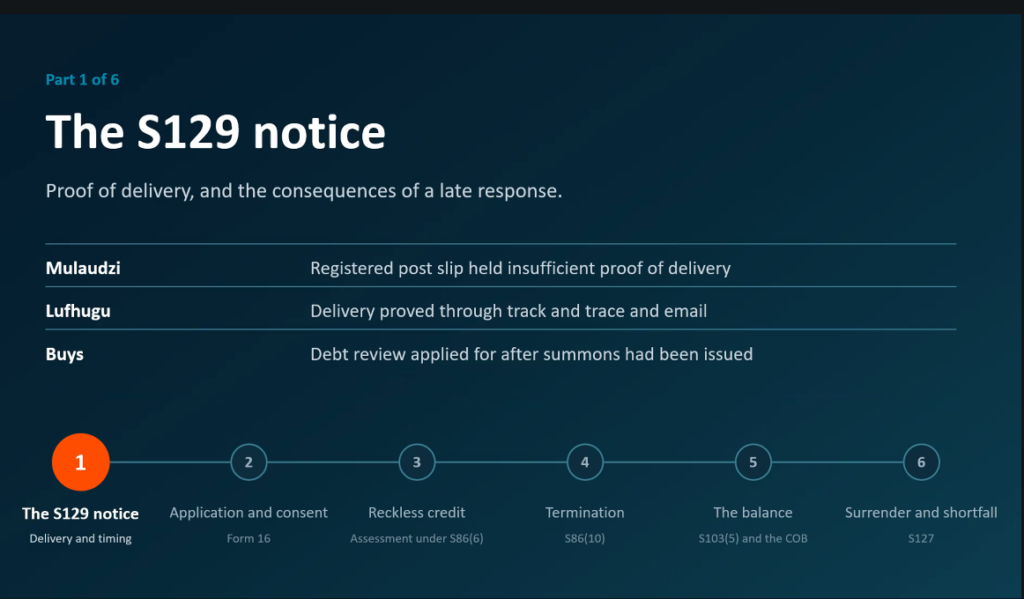
Section 129 Notices
Mulaudzi
In this matter, a registered post slip was not enough to prove that a Section 129 notice had actually been delivered. It only proved that the notice had been sent, not that it had been received.
An in duplum defence was also raised, but the evidence was not strong enough for the court to make a ruling on that aspect of the matter.
The result was that ABSA had to send another Section 129 notice and make sure that it was properly received.
FRB v Lufhungu
This matter also dealt with problems relating to the delivery of a Section 129 notice. The evidence of proper delivery was found to be deficient.
FRB v Buys
In this case, the consumer had responded to a Section 129 notice and later applied for debt review.
The case highlighted that simply making a phone call and offering to pay is not an adequate response to a Section 129 notice if the intention is to reach an arrangement with the credit provider.
Consumers should get any agreement in writing and have a formal arrangement in place in response to the Section 129 demand.
Debt Review Applications and Form 16s
Marajh v National Debt Intervention
In this matter, there was no signed Form 16.
A deceased husband had been placed under debt review without the necessary paperwork being properly completed. The court ordered that the debt review flag be removed at the credit bureaux and referred the matter to the NCR.
It was also alleged that the Debt Counsellor had demanded payment to cancel the debt review.
The Act, regulations and existing declaratory orders may allow the debt review process to begin based on the consumer’s information without a signed Form 16. However, it remains best practice to obtain a signed Form 16, particularly where the matter may later form part of a court process.
NCR v Gedeza
In this matter, signed Form 16 applications could not be found.
The matter was unopposed, so there were no detailed opposing arguments before the Tribunal. Even so, the outcome provides an important reminder for Debt Counsellors.
The NCR had received 216 complaints during the year. It requested information relating to approximately 20 consumer files and found that signed Form 16s were missing. It also identified a number of fees that it did not approve of.
A R1 million fine was imposed, an audit was ordered and the debt counsellor was deregistered.
Some fees had also been collected outside the Payment Distribution Agency process required by the newer Debt Counsellor conditions of registration.
The practical lesson is simple: get signed Form 16 applications and keep proper records.
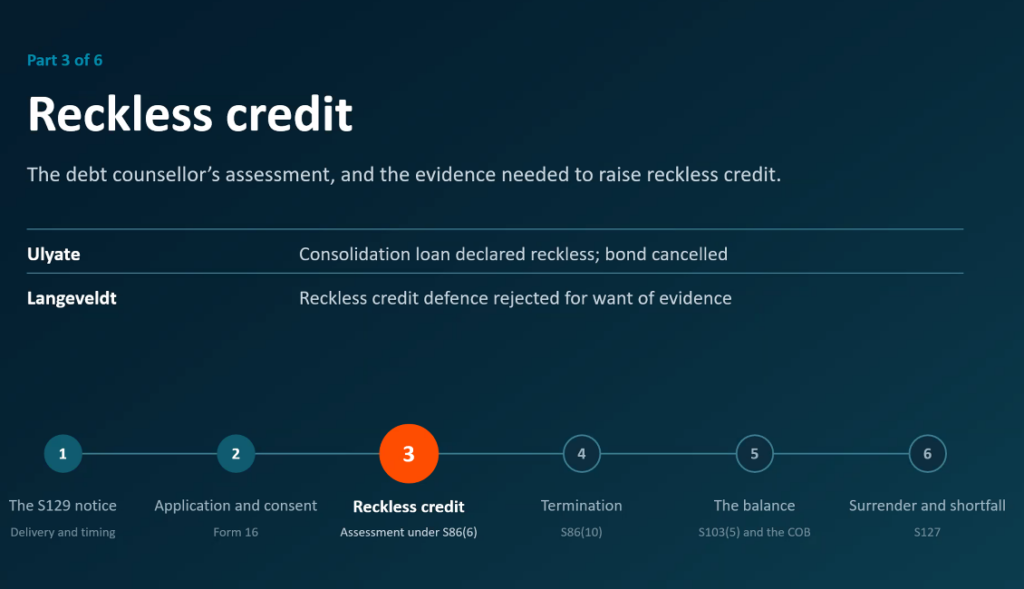
Reckless Credit
Ulyate and Langeveldt
These matters dealt with similar issues but resulted in different rulings, largely because of the evidence that was presented to the courts.
One important issue was whether credit providers should offer credit based on future income that cannot be assured or guaranteed.
In Langeveldt, the court found that the credit offered to the consumer was affordable. The court therefore did not see a need to involve a Debt Counsellor to consider the matter from a debt review perspective, as it was already satisfied that the credit had been affordable.
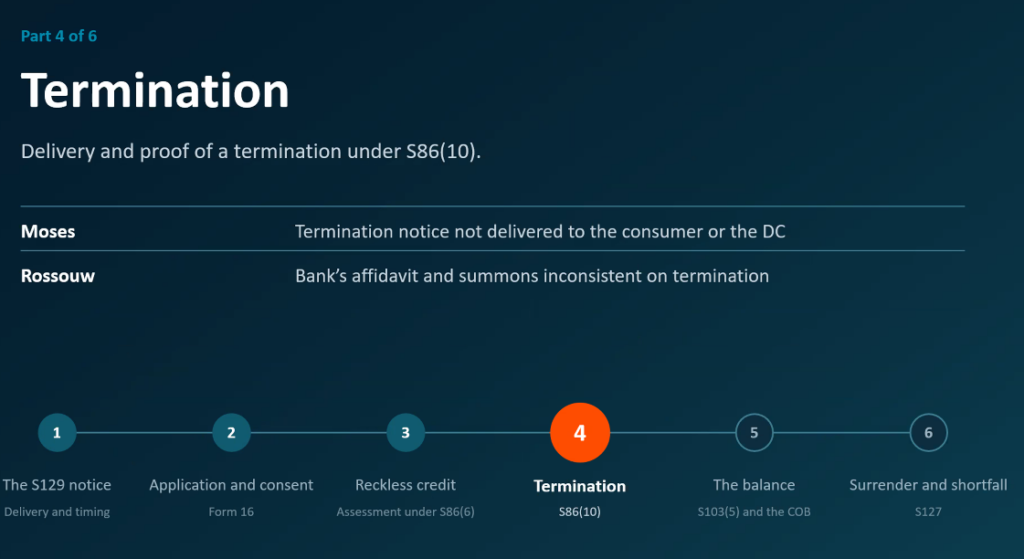
Terminations
Changing Tides v Moses
In this matter, the credit provider could not prove that its termination notice had reached the consumer.
It appeared that the notice had not even reached the consumer’s post office. There was also an error in the Debt Counsellor’s postal address, specifically the postal code, which meant that the notice never reached the Debt Counsellor either.
Because the Section 86(10) termination process had not been completed correctly, there was no need for the account to be placed back under debt review in terms of Section 86(11). The termination had never been properly completed in the first place.
Debt Counsellors should record the date on which they actually receive any termination notice, rather than simply recording the date printed on the notice. They should also keep a clear record of whether the notice was received at all.
Standard Bank v Rossouw
The consumer represented herself in this matter.
The bank said that it had sent a Section 129 notice, although the consumer was already under debt review.
The bank’s application was also late, and the bank did not provide a proper explanation for the delay. The consumer was therefore given leave to defend the matter.
Much of the case depended on establishing an accurate timeline, including information supplied by the Debt Counsellor.
CoBs and Actual Balances
An important question raised during the webinar was whether the arrears balance reflected in legal documents matches the amount shown on the Certificate of Balance, or CoB.
DRY
In this matter, the arrears amount stated in the Section 129 notice was very different from the amount reflected in the Certificate of Balance.
The court held that the arrears amount stated in the Section 129 notice must be accurate for the notice to be valid.
Mbucane
In Mbucane, a significant portion of the arrears shown on the account related to insurance premiums.
The bank did not properly explain why these amounts should have been included in the arrears balance.
Balances Left After Surrendering Vehicles
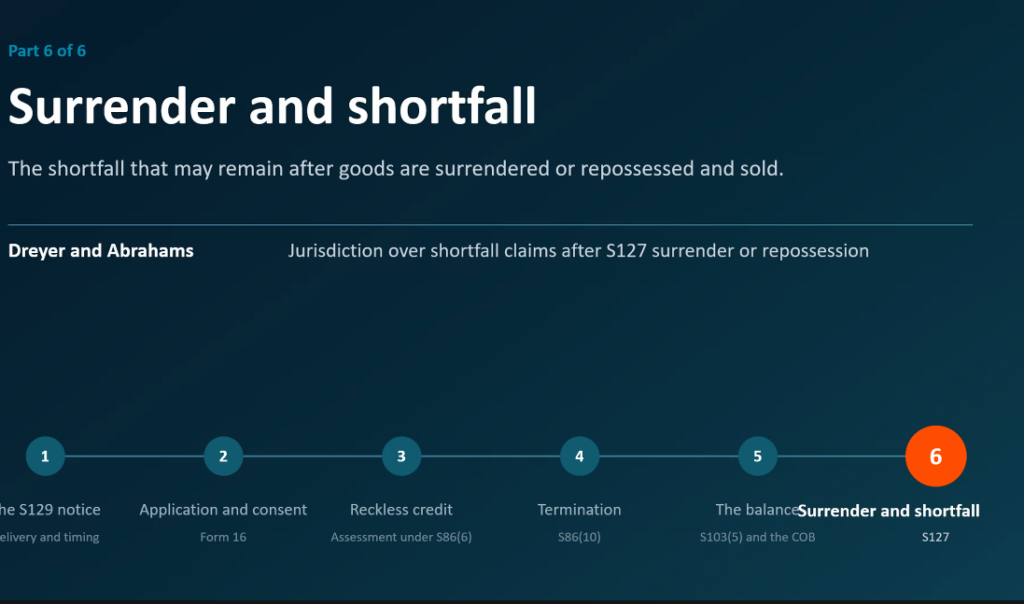
Dreyer and Abrahams
These matters dealt with what happens when a consumer voluntarily returns a vehicle and there is still a shortfall after the vehicle has been sold.
Where a shortfall remains, the credit provider can decide which court it wishes to approach to recover that amount. This may be either the Magistrates’ Court or the High Court.
The practical advice from the webinar was to negotiate strongly before returning the vehicle. Once the credit provider has possession of the vehicle, the balance of negotiating power can shift.
Many credit providers are willing to write off significant portions of a shortfall, so consumers and Debt Counsellors should explore possible settlement arrangements before surrendering the vehicle.
Wrapping Up with Q&As
The session closed with a Q&A with Cornel fielding several questions for clarity or explanations.
There was also a chance for Louise Page of the NCR to stress the importance of Debt Counsellors in getting and keeping records of consumers giving “informed consent”, not just signing a form. This tied in well with several of the cases discussed and is best practice for any industry.
Overall, the webinar was a great success and well received by all who attended. NCR registrants will also receive CPD points for attending.
We use cookies (the computer type not the tasty ones) to ensure that we give you the best experience on our website. If you continue to use this site we will assume that you are happy with it.Yummy, Cookies... OKNo