Reading Time: 6 minutes

Best Practice

Most professional industries have codes of conduct that help shape how practitioners deal with consumers and one another.

They are very common internationally in the field of banking as well as debt collection. They often discuss things like treating customers fairly, disclosure and access to information as well as being honest and having integrity. Many also discuss things like whistleblowing when something appears to be wrong.

They are a helpful guide to professional conduct in any industry.

Credit Industry Codes of Conduct

The credit industry has various codes they adhere to, such as the Code of Banking Practice, the Credit Bureau Association Code of Conduct, Credit Providers Code of Conduct and Credit Industry Code of Conduct for Combatting Over indebtedness.

The Credit Industry Code of Conduct for Combatting Over indebtedness was an interesting one. 

In it you will find references not only debt counselling but also repeatedly to the National Debt Mediation Association (NDMA), which was established (back then) as a way to try and divert people away from their legal right to debt review and debt counselling. This was later openly admitted by the credit provider staff involved at the time.

For the most part, the code committed members to set up systems to deal with over indebtedness and (when not diverting people away to the NDMA) cooperate with debt review. A nice portion of the codes centred around voluntary debt rearrangement, but it seemed to be set up to promote the NDMA and a voluntary debt mediation solution (VDMS), which subsequently also faded away.

The NCR were at the forefront of shutting down VDMS and the NDMA efforts.

Renewed Efforts to Update & Issue Codes

The National Credit Act (NCA) in Section 48 makes provision for the Minister of Trade, Industry and Competition to issue a code of conduct for credit providers.

While the Act does not make provision for issuing codes to other parties, there are, these days, many other parties who operate in the credit industry such as credit bureaus, Payment Distribution Agents(PDAs), Alternative Dispute Resolution Agents(ADRs) and Debt Counsellors.

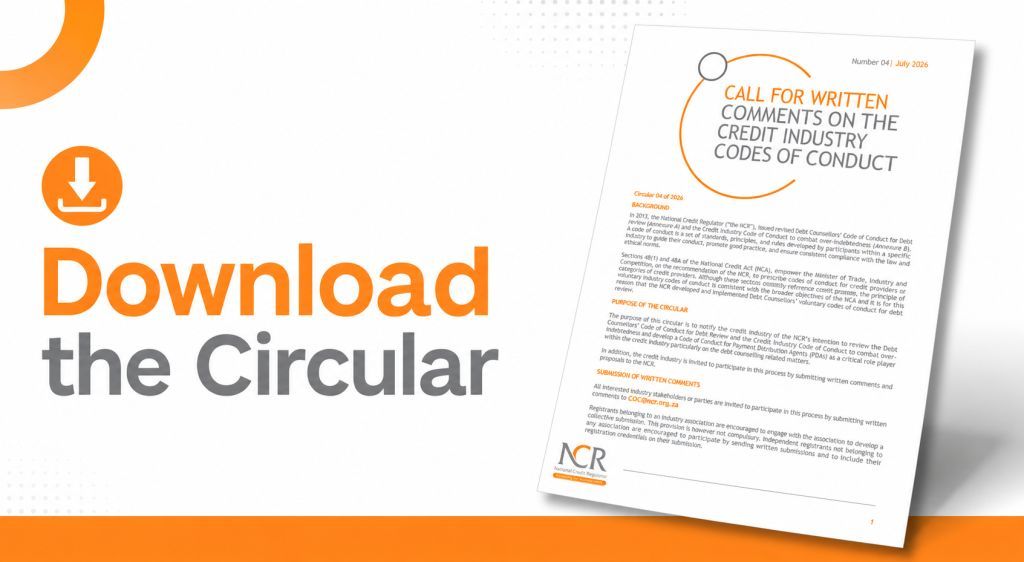
Recently, the NCR sent out a circular (Circular 4 of 2026) that discussed the NCRs desire to work alongside the Credit Industry Forum (CIF), which is an advisory group of industry parties, to come up with a code of conduct for Debt Counsellors.*

There is also talk of potentially trying to draft codes of conduct for Payment Distribution Agents.

It is unclear if the intention is for such codes to be purely voluntary or to somehow try and formally issue them or have the DTIC issue them.

Past problems With Proposed Codes

The NCR have on several occasions in the past, such as 2011 and 2013, issued (voluntary) codes of conduct that it would like Debt Counsellors to follow.

Due to disagreements about the contents of the codes, these have previously been rejected by individual Debt Counsellors and even Debt Counsellor associations.

In 2012, the NCR issued a government gazette retraction of the proposed codes. That same year, various Debt Counsellor associations issued internal codes of conduct for members to subscribe to.

‘That same year, various Debt Counsellor associations issued internal codes of conduct for members to subscribe to’

Since Debt Counsellors have Terms and Conditions of Registration with the NCR. as well as codes of conduct for associations they may belong to, many in the industry felt that an additional (extra legal) code of conduct was simply not necessary and served little purpose.

The wording of the NCA did not then (nor now) make it possible for the DTIC to issue binding codes on Debt Counsellors or possibly other registrants. Changes to the current Act would be needed to facilitate such codes.

In the past, the initial drafts of codes of conduct received a lot of criticism because they appeared to be trying to empower the NCR to create their own rules about debt counselling instead of what appears in the NCA and regulations.

‘they appeared to be trying to empower the NCR to create their own rules about debt counselling’

Since the NCR often issue non binding opinions on matter in the industry (commonly called guidelines), it was feared the NCR would try to enforce such guidelines somehow instead of promoting them as best practice.

Also, there was concern that the codes were forcing people to belong to associations they may not want to join, contrary to the freedom of association enshrined in the SA constitution. People complained that the codes seemed aimed at adding rules rather than trying to shape conduct (such as being honest and showing integrity).

As a result, the codes sort of popped then fizzled. Some people might still voluntarily stick to them today, but Debt Counsellors who belonged to associations, for the most part, decided to rather stick to their association’s codes of conduct.

Others eventually forgot that an attempt had ever been made to issue them.

Calls for Comment

In Circular 4 of 2026 the NCR have called on registrants to comment on the past codes and the drafting of one for Payment Distribution Agents.

The NCR has asked that people submit comments and suggestions. Then such comments and suggestions would be discussed at the CIF helping the NCR develop their own opinion on codes of conduct.

The NCR urged all registrants to comment even if not associated with any particular collective representative association (Eg. DCASA, NDCA, AllProDC, CASA or BASA).


*It also calls for comments about the credit provider codes of conduct.

Hot Topics

Likely to be top of most people’s comment list will be:

Section 1.2 where it says additional measures are needed above and beyond the NCA to successfully complete debt review cases.

Section 1.3 where it says that the NCR’s guidelines would become binding (as opposed to the NCA’s description of them being non binding)

Section 2.1.1 which says that CIF and NCR guidelines would have to be adopted, making them essentially new law.

Section 2.1.2 which talks about an undefined reasonable repayment period but does not define it.

Section 2.1.7 which compels Debt Counsellors to automatically refer every complaint made by clients to the NCR.

Section 2.1.11 which seems to be a reference to DCRS (‘rules’), a BASA calculation engine for calculating debt restructuring proposals.

Section 2.2.4 which repeats that the NCR must be informed of complaints, but this time only those not resolved to the customer’s satisfaction.

Section 2.2.5 to automatically give the consumers documents to lodge complaints with the NCR when starting debt review.

Section 4.2 which requires an annual report about sticking to the code and an additional report of consumer statistics seemingly over and above quarterly statistical reports currently made. The section also has a very vague reference to giving the NCR any statistics they decide to ask for.

Section 5.1 says that only the NCR get to review the code whenever they feel like it but fails to mention any other parties being involved.

It is also likely that there will be comments relating to actually mentioning conduct more. Instead of being a way to add obligations outside of the NCA and regulations people may want to see a drive for Debt Counsellors to show integrity, be honest and treat customers fairly.

Debt Counsellors Earn CPD Here

Title text

Lorem ipsum dolor sit amet, consectetur adipiscing elit. Ut elit tellus, luctus nec ullamcorper mattis, pulvinar dapibus leo.