Why Earning More Doesn’t Always Mean You’re Better Off
August 27, 2026
Reading Time: 7minutes
THE SALARY TRAP
For many South Africans, earning more feels like the obvious way to improve their finances. Earn more, and you should have more money left over each month.
But it does not always work that way.
A higher income can also give you access to more credit, bigger loans and higher credit limits. Before long, those bigger monthly repayments can start eating up the extra money you are earning.
This is one of the interesting issues highlighted by the first South African Financial Pressure Index (SAFPI), an ongoing monthly research project developed by debt counselling practice Debt Solutions 4U using anonymous debt review application data.
The Index looks at something normal economic statistics do not always show clearly: what financial pressure actually looks like inside the homes of South Africans who have reached the point of actually asking for help.
And some of the early findings are worth paying attention to.
THE PROBLEM ISN’T ALWAYS HOW MUCH YOU EARN
One of the first findings from SAFPI is that many consumers entering debt counselling are spending more than half of their income on unsecured debt repayments.
This includes personal loans, credit cards and store accounts.
The median applicant earns under R10 000 a month, carries around R13 439 in unsecured debt and has monthly unsecured debt repayments of about R4 392.
Those numbers tell us something important.
‘consumers entering debt counselling are spending more than half of their income on unsecured debt repayments’
The problem is not simply that people have debt. The real problem is how much of their monthly income is being swallowed up by repayments.
And this is not only a problem for people earning lower incomes.
As your income goes up, your access to credit may also go up. You may qualify for bigger loans and higher credit limits.
That can create a dangerous way of thinking:
“I earn more, so I can afford more.”
But there is a better question to ask:
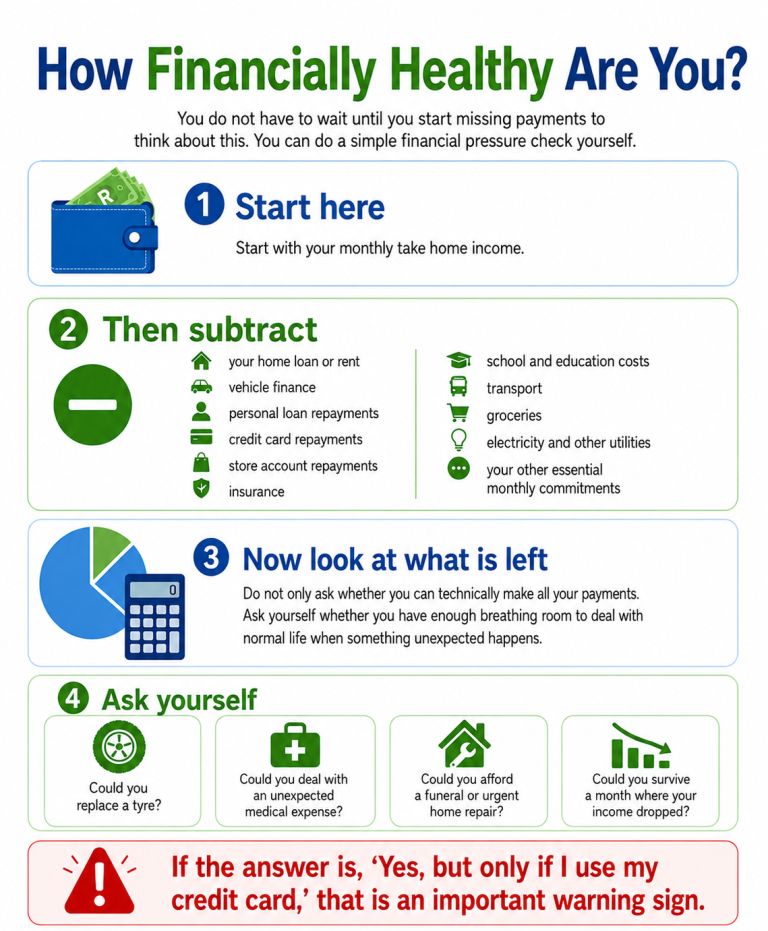
“After all my monthly commitments have been paid, how much money do I actually have left?”
That gives you a much clearer picture of your financial health.
YOUR SALARY IS NOT YOUR SPENDING POWER
Imagine two people.
Person A earns R15 000 a month and has very few debt repayments.
Person B earns R25 000 a month, but has a vehicle loan, two personal loans, credit cards, store accounts and several other monthly commitments.
On paper, Person B earns much more. But Person A may actually have more money available each month and much more financial freedom.
That is why salary alone can be misleading.
Your salary tells you how much money comes in. It does not tell you how much of that money has already been promised to credit providers and other monthly expenses.
The amount in your bank account on payday is therefore not always a good sign of how financially healthy you are.
What matters is how much is left after everything has been paid.
FALLING INTO THE DEBT TRAP
Very few people wake up one morning and decide to get into serious debt.
Usually, it happens slowly.
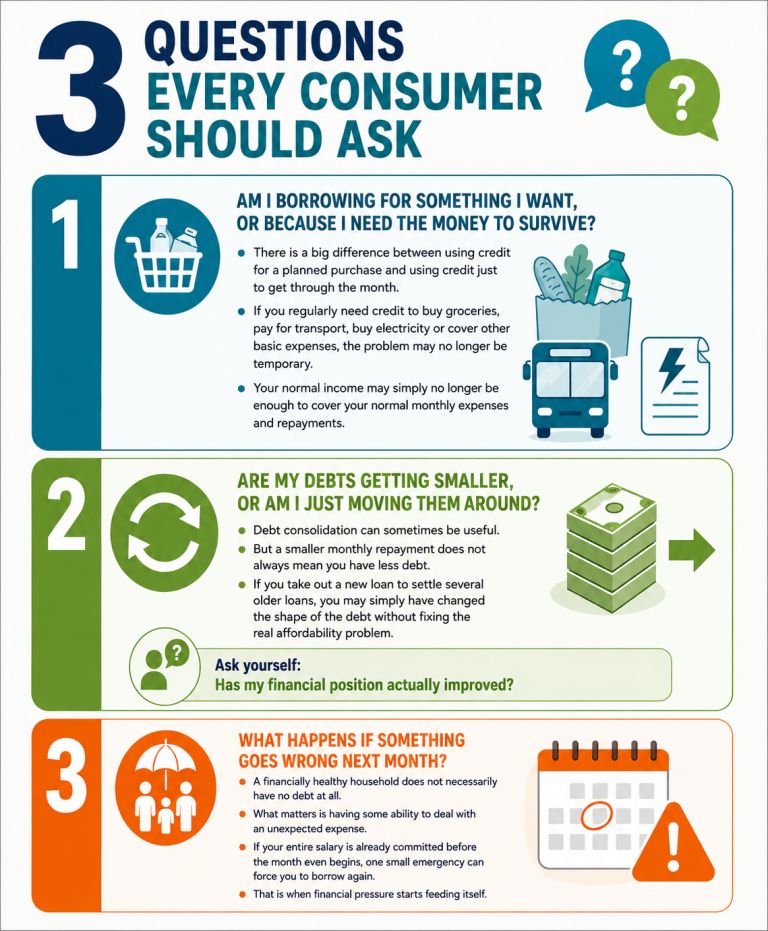
There is an unexpected expense, so a personal loan fills the gap. Then the car needs repairs, so the credit card takes the strain. A few months later, the household budget is even tighter. Another loan is taken to cover the shortfall. Later, some of those debts may be consolidated into a new loan. The monthly repayment might look better, but the household has still used new debt to deal with old debt.
Eventually, credit is no longer being used to buy something extra. It is being used to keep the household going from month to month.
That is when the situation becomes dangerous
LOOK AT THE WHOLE DEBT STACK
It can be easy to look at each debt on its own.
A R1 000 repayment might seem manageable.
So might a different R1 500 repayment.
Another R800 repayment may not look too frightening on its own either.
But together, those three repayments already add up to R3 300 every month.
Now add vehicle finance, insurance, rent or a bond, school costs, groceries, electricity, transport and all the other normal household expenses.
Suddenly, there may be very little salary left over.
That is what financial pressure often looks like.
It is not always one massive debt causing the problem. It can be lots of smaller commitments slowly taking away your financial breathing room.
According to Rowan Breeds, a Director at Debt Solutions 4U who is an experienced Debt Counsellor with more than a decade in the industry, the SAFPI data shows that personal loans deserve particular attention.
Personal loans make up the largest portion of unsecured debt carried by applicants included in the Index.
That makes sense when you look at a household budget.
A store account or phone contract might add some pressure. But a large loan repayment can have a bigger effect on what is left at the end of the month.
And when a new loan is taken to solve an old money problem, the cycle can keep repeating.
DON’T WAIT FOR A CRISIS
One reason the South African Financial Pressure Index is useful is that debt counselling applications give us a picture of consumers at a very specific moment.
These are people who have reached the stage where their existing financial arrangements are no longer working.
But the pressure usually started long before they contacted a Debt Counsellor.
You should therefore not wait until your finances reach crisis point before paying attention.
Warning signs can include regularly:
borrowing money before payday
using one credit account to pay another
taking new loans to settle old ones
paying only the minimum amount on revolving credit
falling behind on accounts
depending on overtime or extra income simply to survive
watching your salary disappear almost immediately after payday
These warning signs do not automatically mean that you need debt review.
But they do mean that it is worth taking a closer look at your finances.
WHAT WE CAN LEARN FROM THE INDEX
The South African Financial Pressure Index is not saying that all credit is bad.
Credit can obviously be useful. A home loan can help someone buy a home today. Vehicle finance can help someone get to work now. A carefully managed loan may help a household deal with a genuine once off expense.
The danger comes when credit stops being a useful financial tool and starts becoming part of your monthly income.
That is when the difference between earning money and having money available becomes very important.
Someone can earn a good salary and still be under serious financial pressure. Someone can have a relatively small amount of debt but still struggle because the monthly repayments are too high. And someone can look financially comfortable from the outside while having almost no room for anything to go wrong.
That is why looking only at how much debt people have does not tell us the whole story.
We also need to look at the financial pressure those debts create each month.
YOUR MOST IMPORTANT FINANCIAL STAT MAY BE ONE YOU NEVER SEE
We often focus on salaries, interest rates and total debt balances.
But one of the most important numbers in your financial life is much simpler:
How much of my income is genuinely mine after all my commitments have been paid?
The more money you have left, the more choices and breathing room you have. The less you have left, the more vulnerable you become when something unexpected happens. And when that amount gets close to zero, the problem may not simply be that you do not earn enough.
It may be that too much of your future income has already been promised to someone else. Perhaps you can only make payments now by replying on more credit. That’s a huge warning sign.
Debt Solutions 4U say that the South African Financial Pressure Index will continue tracking these patterns and they will share as more data becomes available.
Partner Content
Take Back Control
If you are unsure about your financial position and would like a clearer picture of where you stand, Debt Solutions 4U has developed a Free Credit Overview specifically for South African consumers.
Unlike simply looking at your credit score, the Credit Overview gives you a simple snapshot of your overall financial position in one easy to understand report.
Whether you are simply checking your financial health, thinking about applying for credit, struggling with debt or already under debt review, the Credit Overview can help you better understand your current position.
Most importantly, if the Credit Overview shows that you may benefit from professional help, you will have useful information to help you decide what to do next.
That could include looking into debt review, getting help with an existing debt review or understanding how to exit debt review once you have met the legal requirements.
We use cookies (the computer type not the tasty ones) to ensure that we give you the best experience on our website. If you continue to use this site we will assume that you are happy with it.Yummy, Cookies... OKNo